Frequently Asked Questions
The most-asked questions about invertebrates.
What exactly are invertebrates?
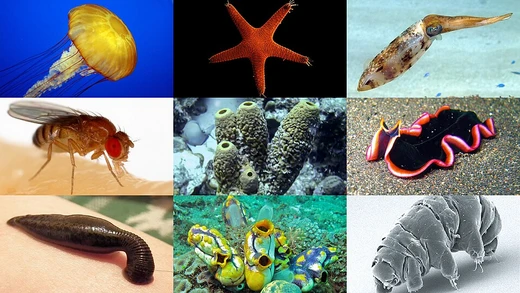
Invertebrates are all animals that lack a backbone or spinal column, accounting for roughly 97 percent of every described animal species on Earth. The group covers an enormous spectrum of body plans, from microscopic rotifers to multi-meter squid.
What are the major groups within invertebrates?
The largest phyla include arthropods (insects, crustaceans, arachnids), mollusks (octopuses, snails, clams), cnidarians (jellyfish, corals), annelids (earthworms, leeches), and echinoderms (starfish, sea urchins). Together these lineages represent the bulk of invertebrate diversity.
Do invertebrates have brains or nervous systems?
Many do, though complexity ranges enormously. Octopuses and squids possess large centralized brains, insects rely on distributed ganglia, and the simplest invertebrates like sponges have no neural tissue at all.
What is the largest invertebrate?
The giant Pacific octopus (Enteroctopus dofleini) is generally regarded as the heaviest invertebrate, with arm spans reaching about five meters and body masses above 60 kg. The colossal squid is a close rival in certain size measurements.
What is the smallest invertebrate?
Certain rotifers and parasitic wasps measure under 0.2 millimeters, making them among the tiniest known animals. Many of these micro-organisms are invisible without magnification.
How far back does the invertebrate lineage extend?
Fossil sponges push invertebrate history to roughly 600 million years, and molecular clocks suggest even earlier origins. The Cambrian explosion around 540 million years ago triggered a rapid burst of distinct invertebrate body plans.
Where do invertebrates live?
They occupy virtually every habitat on the planet—oceans, rivers, soil, deserts, forests, and extreme settings like hydrothermal vents and high-altitude glaciers. In nearly all of these environments they are the numerically dominant animal group.
Why are invertebrates ecologically so important?
They drive nutrient cycling, pollinate the vast majority of flowering plants, anchor most food webs, and build structures such as coral reefs that shelter thousands of other species. Remove invertebrates and most ecosystems would quickly unravel.
Are any invertebrates considered particularly intelligent?
Cephalopods—octopuses, cuttlefish, and squid—stand out for problem-solving, tool use, and short-term memory that rivals some vertebrate species. Certain insects, notably honeybees and bumblebees, also show surprisingly sophisticated learning and communication.
Where should a newcomer start exploring invertebrates?
A practical first step is learning the major phyla and their defining traits, then choosing one group such as arthropods or mollusks to study in depth. Field guides, natural-history museum collections, and open university courses in invertebrate zoology are all accessible entry points.