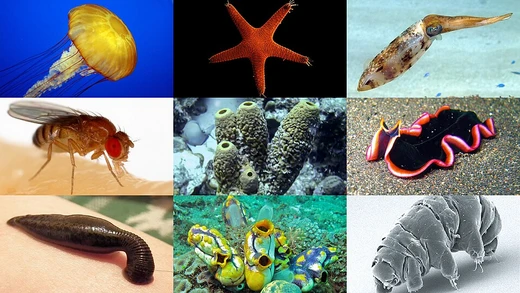
Housefly
A globally distributed fly, pest and research subject.
The housefly (Musca domestica) is a member of the suborder Cyclorrhapha. Its original range is thought to have been the Middle East, but it has since colonized virtually every populated region on Earth, thriving as a commensal of humans. Adults are gray to black insects, distinguished by four dark, longitudinal lines running down the thorax. Their bodies are slightly hairy, and they possess a single pair of membranous wings. The compound eyes are red; in females, these eyes are set farther apart than in males. Female houseflies typically mate just once, storing the sperm for later use. They lay clusters of around one hundred eggs on decaying organic matter such as food scraps, carrion, or feces. These eggs soon hatch into legless, white larvae known as maggots. After two to five days of development, the maggots transform into reddish-brown pupae. Adult flies generally live for two to four weeks, though they can hibernate through the winter. Adults feed on liquids or semi-liquids, and they can soften solid foods with their saliva before consuming them. Houseflies are considered pests because they can carry pathogens on their bodies and in their feces, contaminating food and contributing to the spread of food-borne illnesses; in large numbers, they also cause physical annoyance. Despite this, they have proven useful in laboratory research, particularly for studies on aging and sex determination, due to their short life cycles and ease of maintenance. Houseflies have appeared in literature since ancient Greek myth and Aesop’s fables, and writers such as William Blake have used them to reflect on the brevity of life.
- field
- Entomology
- known_for
- Widespread pest, vector of pathogens, model organism for aging and sex determination research
- distribution
- Worldwide, from Arctic to tropics
Lore & Background
Adult houseflies are gray to black insects, with four dark, longitudinal lines running along the thorax and a body covered in short hairs. They possess a single pair of membranous wings; the hind pair is reduced to small halteres that stabilize flight. The wings are translucent with a yellowish base, and the medial vein features a sharp upward bend. Each wing has a lobe called the calypter covering the haltere. The abdomen is gray or yellowish with a dark stripe and irregular dark markings on the sides, consisting of ten segments with spiracles for breathing. Males have claspers on the ninth segment for mating, while both sexes have anal cerci on the tenth. The head is strongly convex in front and flat behind, with three simple eyes (ocelli) and a pair of short antennae. The large compound eyes are almost touching in males but more widely separated in females, which are slightly larger overall. Females also tend to have larger wings, while males have longer legs. Their mouthparts form a retractable, flexible proboscis with a sponge-like tip called the labellum, which has grooves (pseudotracheae) that suck up liquids by capillary action and distribute saliva to soften solid food. Chemoreceptors on the legs allow them to taste sugars by walking over them; they frequently clean their legs to refresh these sensors. Each leg ends in a pair of claws and two adhesive pads (pulvilli), which enable walking on smooth walls and ceilings using Van der Waals forces; the claws help detach the foot for the next step. On horizontal and vertical surfaces, they walk with three legs in contact and three moving, but on inverted surfaces they keep four feet stuck. They land on ceilings by flying straight toward it, then performing a half-roll to point all six legs at the surface, absorbing the shock with the front legs before sticking with the others. The housefly is the most widely distributed insect, found in the Arctic, tropics, and all populated continents, having spread globally as a commensal of humans from its likely origin in the Middle East.
Reader's Guide
The housefly is significant as a ubiquitous pest associated with humans, capable of carrying pathogens on its body and in feces, contaminating food, and transferring food-borne illnesses. Its short life cycle and ease of maintenance have made it useful for laboratory research into aging and sex determination. Its worldwide distribution, from the Arctic to the tropics, underscores its close commensal relationship with humans, likely spread through co-migration. The housefly's ability to process visual information seven times faster than humans helps it avoid capture, contributing to its success as a pest.
Did You Know?
- Female houseflies normally mate only once and store sperm for later use.
- Houseflies process visual information around seven times faster than humans, enabling them to avoid swatting.
- The housefly has chemoreceptors on the tarsi of its legs, allowing it to identify foods by walking over them.
- Houseflies can walk up smooth walls and ceilings using Van der Waals forces via adhesive pads on their feet.
Frequently Asked Questions
What is the housefly?
The housefly (Musca domestica) is a small, bristly fly in the suborder Cyclorrhapha that has become one of the most universally recognized insect pests on Earth. It is found in virtually every human-inhabited region, ranging from Arctic settlements to tropical cities.
Where did the housefly come from?
The species is believed to have first emerged in the Middle East, where it settled into a commensal relationship with human communities. From that origin it spread along trade routes and with migrating people until it established populations across the entire globe.
Why is the housefly such a notorious pest?
It constantly lands on exposed food and surfaces, picking up and depositing pathogens that can cause food-borne illness. In large numbers its relentless buzzing, crawling, and egg-laying near waste make it a major nuisance in homes and food-processing facilities.
What role does the housefly play in scientific research?
Beyond its pest reputation, Musca domestica is used as a laboratory model organism, particularly for investigating the biology of aging and the genetic pathways that determine sex. Its short generation time and ease of rearing in controlled conditions make it a practical subject for those studies.
How long does a housefly live?
An adult typically survives only about two to four weeks under normal conditions, though individuals raised in a lab can occasionally push a little beyond that range. This brief lifespan, paired with rapid egg-laying, allows local populations to surge quickly during warm months.
More in Invertebrates 1-24
Spotted an error? Know more?
This is a living reference — every entry is fact-audited, and reader corrections feed straight into our audit queue. Suggest an edit · See this site's audit record