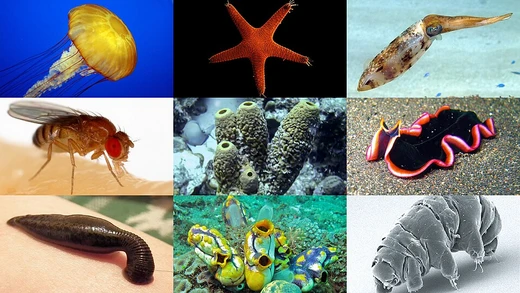
Echinoderm
Marine animals with five-pointed radial symmetry and unique water vascular system.

Echinoderms are animals of the phylum Echinodermata, including starfish, brittle stars, sea urchins, sand dollars, sea cucumbers, and sea lilies. They are found on the sea bed at every ocean depth, from the intertidal zone to the abyssal zone, and are important both ecologically and geologically. Ecologically, they are abundant in deep and shallow oceans; geologically, their ossified dermal endoskeletons contribute to limestone formations and provide clues about geological environments.
- field
- Marine biology, paleontology
- known_for
- Pentamerous radial symmetry, water vascular system, regenerative ability
- first_appearance
- near the start of the Cambrian
Lore & Background
Echinoderms evolved from bilaterally symmetrical ancestors. As larvae, they are free-swimming and bilaterally symmetrical, but during metamorphosis the left side grows at the expense of the right, resulting in pentaradial symmetry in adults. Most echinoderms have five-part symmetry, though some starfish and brittle stars have six or more arms. The name 'echinoderm' comes from Ancient Greek for 'hedgehog skin', referencing their spiny appearance.
Reader's Guide
Echinoderms are significant for their ecological abundance in marine environments and their geological role in forming limestone deposits. Their ossified endoskeletons, composed of calcite with a porous stereom structure, fossilize readily and help paleontologists interpret ancient environments. They were the most used species in regenerative research in the 19th and 20th centuries, as many can reproduce asexually and regenerate tissue, organs, and limbs—some can regenerate entirely from a single limb. Some scientists hold that the radiation of echinoderms was responsible for the Mesozoic Marine Revolution. Their unique water vascular system, used for locomotion, feeding, and gas exchange, is a defining feature. The phylum includes five extant classes: Asteroidea, Ophiuroidea, Echinoidea, Holothuroidea, and Crinoidea.
Did You Know?
- The name 'echinoderm' means 'hedgehog skin' in Ancient Greek.
- Some echinoderms can regenerate an entire body from a single limb.
- The first definitive echinoderms appeared near the start of the Cambrian.
More in Invertebrates 1-24
Elsewhere in the Invertebrates universe
Spotted an error? Know more?
This is a living reference — every entry is fact-audited, and reader corrections feed straight into our audit queue. Suggest an edit · See this site's audit record