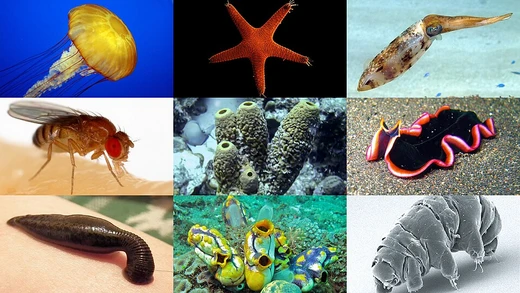
Insect
Insects are the most diverse group of animals on Earth.

Insects are invertebrates of the class Insecta, the largest group within the arthropod phylum. They are the most diverse group of animals, with more than a million described species, representing more than half of all animal species. Insects have an exoskeleton, a three-part body (head, thorax, and abdomen), three pairs of jointed legs, compound eyes, and a pair of antennae. They are distributed over every continent and almost every terrestrial habitat, with many more species in the tropics than in temperate zones.
- field
- Biology, Entomology
- known_for
- Most diverse group of animals; only invertebrates with sustained powered flight; essential pollinators; coevolved with flowering plants
Lore & Background
The word insect comes from the Latin insectum, meaning 'cut up,' referring to their three-part body. Aristotle first described insects as a distinct group, placing them on his scala naturae.
Reader's Guide
Insects are ecologically essential, particularly as pollinators for many flowering plants, and as predators of pest insects. They also provide direct economic benefits through domesticated species like silkworms for silk and honey bees for honey. Humans intentionally consume insects as food in 80% of the world's nations. However, human activities are having serious effects on insect biodiversity. Many insects are considered pests, damaging crops, and some act as vectors of diseases. Estimates suggest there may be around 5.5 million insect species in existence, with about one million described.
Did You Know?
- Insects are the only invertebrates that can achieve sustained powered flight; insect flight evolved just once.
- Fossilized insects from the Paleozoic era include giant dragonfly-like insects with wingspans of 55 to 70 cm.
- Male moths can sense the pheromones of female moths over great distances.
- Some insects, such as water striders, can walk on the surface of water.
Frequently Asked Questions
What defines an insect?
Insects are arthropods belonging to the class Insecta, distinguished by a hard outer shell, a body split into head, thorax, and abdomen, six jointed legs, compound eyes, and a single pair of antennae.
Why are insects considered the most diverse group of animals?
With more than a million described species, insects make up over half of all known animal species on the planet. No other animal group approaches that level of variety.
What makes insects unique among invertebrates?
Insects are the only invertebrates capable of sustained, powered flight, a trait that has let them colonize virtually every land-based habitat on Earth. This flight ability has been a major driver of their evolutionary radiation.
How do insects benefit the wider ecosystem?
Many insect species act as essential pollinators and coevolved alongside flowering plants in one of nature's most critical mutualistic relationships. Without them, a large share of plant reproduction would collapse.
Where are insects found, and where are they most abundant?
Insects inhabit every continent and nearly all terrestrial environments, though tropical regions host far more species than temperate ones. Their range is essentially global across land-based ecosystems.
More in Invertebrates 25-40
Elsewhere in the Invertebrates universe
Spotted an error? Know more?
This is a living reference — every entry is fact-audited, and reader corrections feed straight into our audit queue. Suggest an edit · See this site's audit record