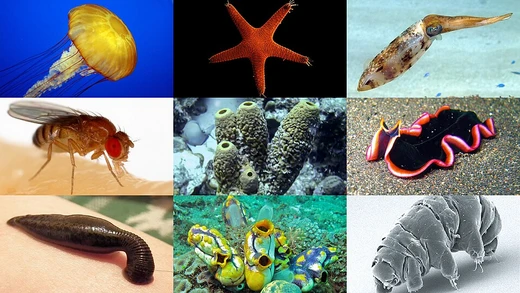
Leech
Parasitic or predatory worms used in medicine since ancient times.

Leeches are segmented parasitic or predatory worms comprising the subclass Hirudinea within the phylum Annelida. They are closely related to earthworms and have soft, muscular segmented bodies that can lengthen and contract. Most leeches live in freshwater, though some are terrestrial or marine. The best-known species, such as the medicinal leech, are hematophagous, feeding on blood after secreting the anticoagulant hirudin. Leeches have been used in medicine from ancient times until the 19th century to draw blood, and in modern times find use in treating joint diseases, extremity vein diseases, and microsurgery.
- field
- Zoology (Hirudinea)
- known_for
- Blood-feeding behavior, medical use of hirudin, and role in historical bloodletting
- largest_species
- Giant Amazonian leech, Haementeria ghilianii, up to 30 cm
- habitat
- Worldwide except Antarctica; most abundant in temperate lakes and ponds in the northern hemisphere
Lore & Background
Leeches are hermaphrodites with a clitellum, and typically have suckers at both ends and ring markings that do not correspond with internal segmentation. Their coelom is reduced to small channels. The jaws used to pierce skin are replaced in some species by a proboscis. A minority of leech species are predatory, mostly preying on small invertebrates. Eggs are enclosed in a cocoon; in the family Glossiphoniidae, parents brood the eggs and carry young on the underside of their bodies. Some species aestivate during droughts, burying themselves in sediment and losing up to 90% of bodyweight yet surviving. The name Hirudinea comes from Latin hirudo, meaning leech; the element -bdella is from Greek βδέλλα, also meaning leech. Leeches were traditionally divided into two infraclasses: Acanthobdellidea (primitive leeches) and Euhirudinea (true leeches). The true leeches are further divided into proboscis-bearing Rhynchobdellida and the rest, including some jawed species, the Arhynchobdellida. The most ancient annelid group consists of free-living polychaetes from the Cambrian; oligochaetes evolved from polychaetes, and leeches branched off from oligochaetes.
Reader's Guide
Leeches have a dual significance: as biological organisms and as tools in medicine. Their ability to secrete hirudin, a powerful anticoagulant, has made them valuable in treating blood-clotting disorders and in microsurgery to restore blood flow. Historically, they were central to bloodletting practices from ancient times through the 19th century. Ecologically, leeches are both parasites and predators, inhabiting freshwater, terrestrial, and marine environments worldwide except Antarctica. They are prey to fish, birds, and invertebrates. The leech also appears in the biblical Book of Proverbs as an archetype of insatiable greed, and the term 'leech' is used to characterize a person who takes without giving. Their phylogenetic relationships show that leeches are derived from oligochaete ancestors, and the earliest leeches were likely ancestrally marine, later transitioning to freshwater. The fossil record includes a stem-leech from the Silurian period, though its identification remains debated.
Did You Know?
- The giant Amazonian leech, Haementeria ghilianii, can reach 30 cm in length.
- Some leech species can lose up to 90% of their bodyweight during drought and still survive.
- The family Glossiphoniidae is unique among annelids in brooding eggs and carrying young on the underside of the body.
Frequently Asked Questions
What exactly is a leech?
A leech is a soft-bodied, segmented worm belonging to the subclass Hirudinea within the phylum Annelida, making it a close relative of earthworms. Its muscular body allows it to stretch and contract, and it is classified as either a parasite or a predator depending on the species.
What are leeches most famous for?
Leeches are best known for their blood-feeding (hematophagous) behavior, during which they secrete the anticoagulant hirudin to keep blood flowing while they feed. They also gained historical notoriety as tools for bloodletting in medicine from ancient times through the 19th century.
Where can you find leeches in the wild?
Leeches occur on every continent except Antarctica, with the highest concentrations in temperate lakes and ponds across the northern hemisphere. While most species inhabit freshwater, some have adapted to terrestrial or marine environments.
What is the largest species of leech?
The Giant Amazonian leech, Haementeria ghilianii, holds the record, reaching lengths of up to 30 centimeters. It is native to the Amazon basin and dwarfs the small freshwater species most people encounter in ponds.
Do leeches have any modern medical uses?
Yes—despite falling out of favor for bloodletting in the 1800s, leeches are still applied in modern medicine to treat certain joint disorders and venous disease of the extremities. Their saliva, rich in hirudin, helps prevent unwanted clotting at the site of application.
More in Invertebrates 25-40
Elsewhere in the Invertebrates universe
Spotted an error? Know more?
This is a living reference — every entry is fact-audited, and reader corrections feed straight into our audit queue. Suggest an edit · See this site's audit record